



London’s nightlife is under threat. Costs for late-night venues are rising, humble pubs are struggling, and the capital’s independent Nightlife Taskforce, established by Sadiq Khan in 2025, has warned that the night-time economy is in decline due to pressures including planning, licensing, transport and safety.
A good night out isn’t kind to the pockets either. And yet, nightlife has long been vital to LGBTQ+ communities, offering a cloak of safety that can be harder to find in the daytime. Ballroom culture remains one of the most profound examples. Emerging among Black and Latino queer and trans communities in New York City, it was built in response to exclusion from mainstream society, and even parts of the wider LGBTQ+ scene. At its core are chosen families, or “houses”, usually led by “mothers”, or “fathers”, who mentor young members seeking support and community. They teach vogueing, performance and self-presentation, with houses competing at events known as balls.
While late-night balls remain central, ballroom has evolved. Daytime functions, workshops and festivals are increasingly common as the culture gains visibility. In Stratford this past February, that evolution took shape with the launch of The Lab – a new Vogue function aiming to honour ballroom’s foundations while serving something different.
The Lab is the brainchild of Cyrus and Matthew, who had been developing the idea since late 2024. With support from Creative Newham, an arts and education alliance in the borough, Cyrus secured funding for an event in accordance with the borough’s LGBT History Month theme of Science and Innovation. The Lab, a familiar term in ballroom culture, felt like a natural fit. The event was delivered with support from Newham Council and Creative Newham.
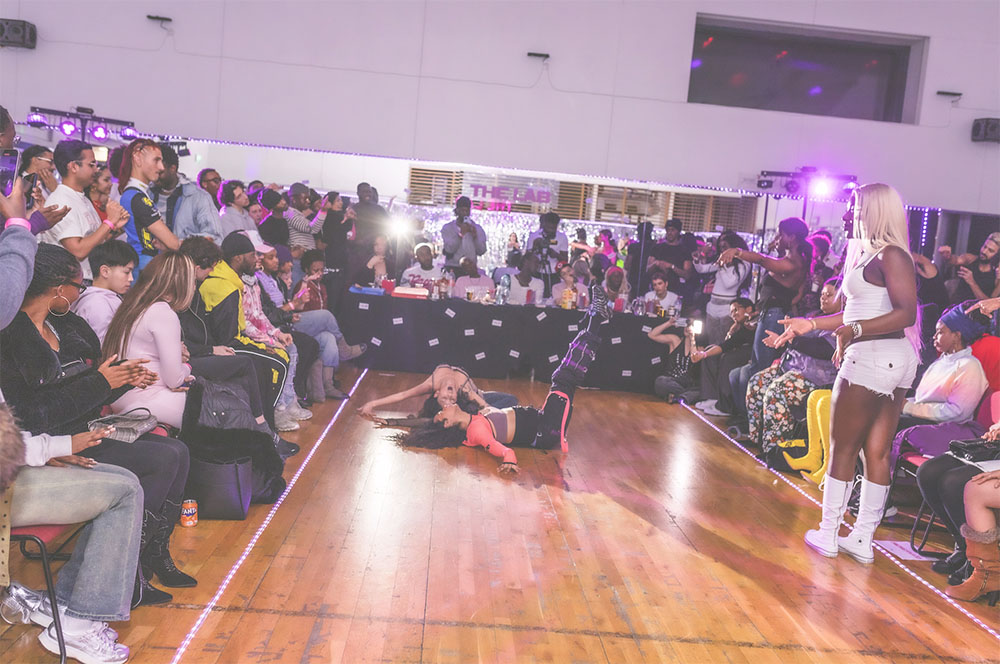
Cyrus grew up in Newham, watching it transform after the Olympic Village development while retaining some of the style and presence of young queer people of colour raised there and nearby. With the borough also hosting UK Black Pride in recent years, he feels preserving ballroom spaces is increasingly important. “I don’t see many spaces for us in such environments, and if they do exist, they’re slowly beginning to die out,” he tells Beast.
Matthew, from south London, was supported by his house, Unbothered Cartier. He has been part of the scene for over four years, first slipping into clubs at a “tender age, just to be outside with my queer friends in Yardie and gay scenes”, before finding affirmation and freedom in east London nightlife.
“We wanted to deliver something that was made for the community by the community but also bring back the playfulness to the Ballroom scene,” Cyrus adds.
That intention shapes The Lab’s philosophy. “With this space, I want people to feel like they can reimagine themselves,” Matthew explains. “The Lab is intended to let anybody feel free to express themselves without worry or competition – while allowing the space for competitive energy and affirmative choices. Highlighting queer and trans POC, pinnacle to the scene, we host a space for the challenge of letting things go.”
There is a growing urgency felt in the community around the preservation of Black and POC-focused queer spaces. People therefore flocked to Stratford and showed up and showed out: vogueing, sashaying, devouring. “I got to live my dream,” said Saffron, a guest.
“Confidence comes with being sure of yourself,” Matthew adds. “In The Lab, I want people not to feel challenged but to feel compelled to show up for themselves, regardless of whether they are walking or supporting.”
The event also secured a partnership with Benefit Cosmetics – its first collaboration with a queer-focused, community-led event – alongside sexual health testing and advice from The Love Tank.
London’s ballroom scene has long been shaped by staple events, from VogueRites’ Vogue Night to Karteer Telfar’s Get Busy, alongside club nights like Bootylicious. Cyrus and Matthew see The Lab as part of a lineage. “We told Ryan [Central member and co-producer of Pxssy Palace] that The Lab is the baby of Pxssy Palace.”
Looking ahead, their focus is on growth without dilution. “To evolve and continue experimenting, so it’s not the same as other Ballroom functions,” says Cyrus. “As it was built from the Ballroom scene, it will always have an element of that but wouldn’t always be your usual Ball or Vogue Night type of event.”
“I want to see the space evolve so people outside of the ballroom community can feel welcome to the space we’re creating, whilst we keep elements of the scene at the core of our venture.”